Moonshine and Secrecy in Appalachia During Prohibition
- mapa303
- 6 hours ago
- 7 min read
How prohibition changed daily life in Appalachia
By: McKenzie Pasley
The Prohibition era in the United States lasted from 1920 to 1933 and banned the production sale and transportation of alcohol. In Appalachian Kentucky this law affected communities that already had a long history of making moonshine. For many families moonshine was more than illegal activity. It was part of everyday life and a way to survive during difficult economic times. People continued producing alcohol in secret by hiding stills in remote wooded areas and avoiding law enforcement. This digital story explores how moonshiners adapted during Prohibition and how secrecy shaped everyday life in Appalachian communities.

Hidden Moonshine Operations
Moonshine production during Prohibition depended heavily on secrecy. Many stills were hidden deep in wooded areas away from towns and law enforcement. People involved in illegal alcohol production often used coded language and slang connected to moonshine culture. Terms such as “white lightning”, “mountain dew”, and “bone dry” were commonly used in court records during the Prohibition era (Barker). These terms reflected how common moonshine had become in Appalachian communities and how people created their own language around illegal alcohol production.
Images of moonshine stills also show how carefully these hidden operations were planned. Barrels pipes and open fires were used to produce alcohol in remote outdoor areas surrounded by trees. These locations helped reduce the chances of being discovered and showed how much planning went into avoiding detection. Oral histories from people who lived during Prohibition describe strategies such as working at night and choosing isolated locations far from roads or towns. Avoiding law enforcement became part of daily life because being caught could lead to arrests fines or jail time.
Moonshine and Family Survival
Many people involved in moonshine production did not see it as simple criminal activity. For families living in poverty it was often viewed as necessary work that helped provide food and money. In interviews from the Nunn Center former moonshiner Tommy Strunk explained that moonshine was part of everyday life in Appalachian communities and became a way for many families to survive during difficult economic times (Strunk). Some families struggled to find stable jobs especially during the winter months and moonshine became one of the only reliable ways to make money.
The interviews also describe the dangers connected to moonshine production. Explosions while making moonshine were common and many workers risked injury or arrest. Even with these dangers people continued producing alcohol because they felt they had few other options. Strunk explained that many people were not trying to hurt others but were simply trying to provide for their families through moonshine production (Strunk). Law enforcement officer Jack Miller also discussed the differences between traditional moonshine and modern illegal alcohol production which shows how attitudes toward moonshine changed over time (Miller).
Avoiding law enforcement
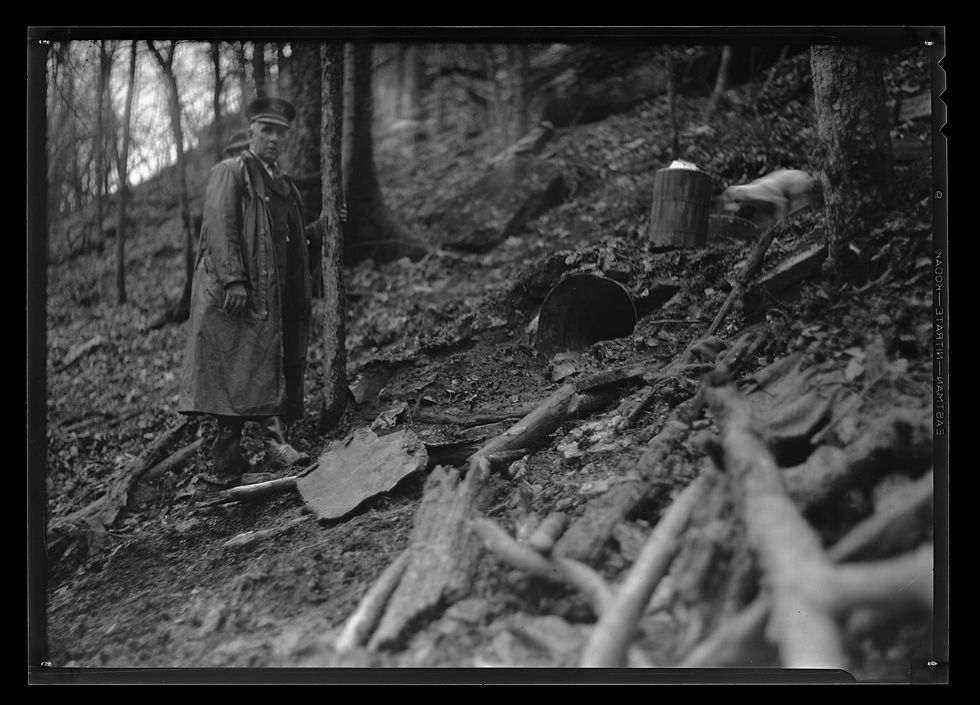
Because moonshine production was illegal people had to find ways to avoid getting caught. Many stills were hidden deep in wooded areas far away from towns and roads. Remote locations made it harder for law enforcement officers to discover illegal operations and helped moonshiners continue production in secret. Images from the Prohibition era show stills hidden in forests and surrounded by natural cover which reflects how important secrecy became during this time.
Many moonshiners worked at night or moved their operations often to lower the risk of being discovered. Oral histories from the Nunn Center describe how secrecy became part of everyday life because people knew they could face raids arrests or jail time if they were caught (Strunk). This pressure caused many people to carefully choose who they trusted and what information they shared with others. Hidden production sites and secret routines became normal parts of life in some Appalachian communities during Prohibition.
Law enforcement officers regularly searched for illegal stills and destroyed them once they were discovered. Photographs from Kentucky during the Prohibition era show prohibition agents standing beside confiscated moonshine equipment after raids were completed. These images help show the constant conflict between moonshiners and law enforcement and explain why secrecy became necessary for many producers.
Moonshine and Appalachian Identity
Although moonshine was illegal during Prohibition it later became closely connected to Appalachian identity and culture. Over time the image of moonshiners changed from dangerous criminals to symbols of independence survival and mountain tradition. Stories about moonshine continued to be passed down through families and communities even after Prohibition ended. This helped preserve the history of moonshining in eastern Kentucky and other Appalachian regions.
Photographs from Kentucky after Prohibition show people openly referencing moonshine during public events and celebrations. One image from a Lexington homecoming parade shows people dressed as “hillbillies” carrying a barrel meant to represent moonshine. This reflects how moonshine became part of public memory and Appalachian stereotypes rather than something completely hidden from society. What once had to remain secret slowly became connected to local pride history and tourism.
Today moonshine history is still used to attract visitors and teach people about Appalachian culture. According to WEKU the Moonshine Trail was created to connect distilleries and landmarks across eastern Kentucky while sharing the history behind moonshine production (Snyder). Ben Pasley explained that moonshine was once “a way to literally put food on the table to provide for a family” in communities with limited opportunities (Snyder). This shows how moonshine changed from a hidden survival strategy during Prohibition into a lasting symbol of Kentucky history identity and tourism.

The risks and declining of Moonshine
Moonshine production came with serious risks for the people involved. Distilling alcohol in hidden outdoor stills could be dangerous because of fires explosions and unsafe working conditions. Many moonshiners were not trying to harm others but were simply attempting to make enough money to support their families during difficult economic times (Strunk). Even so the illegal nature of moonshining meant that producers constantly faced the risk of arrest fines and losing property.
Law enforcement efforts against moonshining became stronger over time. Charles Dause explained that federal agents and courts became more involved in moonshine cases throughout Kentucky which made it harder for illegal distillers to continue operating without being discovered (Dause). Surveillance investigations and stricter enforcement caused traditional moonshine production to decline after the 1970s. Many hidden stills were eventually located and confiscated by authorities.
As moonshining became more difficult and risky fewer families relied on it as a source of income. Economic changes and increased policing slowly reduced the number of traditional moonshine operations in Appalachia. Even though illegal production declined the stories and experiences connected to moonshine continued to remain an important part of Appalachian history and culture.
Moonshine's Legacy in Modern Kentucky
Even after Prohibition ended moonshine continued to influence Appalachian culture and identity. What was once hidden in the mountains slowly became something discussed more openly through family stories tourism and local traditions. In eastern Kentucky moonshine history is now used to teach visitors about the struggles many Appalachian families faced and the ways communities survived during difficult economic times. The Moonshine Trail was created to connect distilleries and historical landmarks across eastern Kentucky while preserving local culture and history (Snyder).
Modern distilleries connected to the Moonshine Trail often emphasize family history and traditional Appalachian methods. Snyder explains that many of these businesses are small family owned operations rather than large corporate distilleries. Distiller Andrew Tyma explained that moonshine production allows more experimentation with flavors and recipes than traditional bourbon production (Snyder). Distillers now create legal versions of moonshine using fruit flavors different barrels and updated distilling methods while still connecting their products to Appalachian traditions.
The article also describes how some distillery owners come from families connected to earlier moonshining culture. Kentucky Mist Distillery owner Colin Fultz explained that stories about his family’s involvement with moonshine inspired him to learn distilling himself (Snyder). Fultz stated that older moonshine was often rougher because distillers lacked the equipment and technology available today (Snyder). These modern businesses show how moonshine history has changed from a hidden illegal activity into a source of tourism local pride and economic opportunity in Appalachia.
Today moonshine remains an important symbol of Appalachian identity because it reflects both hardship and resilience. Communities that once hid illegal stills in remote mountains now openly share these stories through museums trails and tourism projects. Although moonshine production during Prohibition involved secrecy and danger its history continues to shape how many people understand eastern Kentucky culture today.
Understanding the Whole Picture
Moonshine during Prohibition was more than illegal alcohol production in Appalachian Kentucky. It affected daily life family survival and relationships with law enforcement across many mountain communities. People hid stills in remote areas created coded language and relied on secrecy to continue making money during difficult economic conditions. Oral histories photographs and modern tourism projects show how moonshine shaped Appalachian culture long after Prohibition ended.
The history of moonshining also reveals the complicated relationship between poverty survival and the law. Many families viewed moonshine as one of the only ways to support themselves when stable jobs were unavailable. Although moonshine production involved serious risks and legal consequences it later became an important part of regional identity and historical memory. Today the stories traditions and images connected to moonshine continue to influence how people understand Appalachian history and culture.
Works Cited
Barker, Melissa. “Deciphering Moonshine Lingo in Court Records.” Kentucky Genealogical Society, 18 Feb. 2023, kygs.org/deciphering-moonshine-lingo-in-court-records/. Accessed 13 Apr. 2026.
Dause, Charles L. “Interview.” 30 Mar. 1988. Kentucky Oral History Collection, University of Kentucky Libraries, kentuckyoralhistory.org/ark:/16417/xt70zp3vv043.
Lafayette Studios. Raid on Moonshine Still, South Limestone Street; Prohibition Agents (Lexington Leader). 1931. ExploreUK, University of Kentucky Libraries, exploreuk.uky.edu/catalog/xt702v2c8t1s_408_1?q=moonshine&per_page=20.
“Making ‘Moonshine’ in Kentucky KE-20.” ExploreUK, University of Kentucky Libraries, exploreuk.uky.edu/catalog/xt7x696zwx82_1184_1?q=moonshine&per_page=20.
Miller, Jack C., and Tommy Strunk. “Interview.” 1 Apr. 1988. Kentucky Oral History Collection, University of Kentucky Libraries, kentuckyoralhistory.org/ark:/16417/xt7rfj29b431.
Snyder, Shepherd. “Moonshine Trail Looks to Get Tourists’ Eyes on Eastern Kentucky through Local History, Culture.” WEKU, 15 Nov. 2023, weku.org/the-commonwealth/2023-11-15/moonshine-trail-looks-to-get-tourists-eyes-on-eastern-kentucky-through-local-history-culture. Accessed 13 Apr. 2026.
University of Kentucky. Homecoming Parade, People Dressed as “Hillbillies” with Moonshine in a Barrel, Downtown Lexington. 1954. ExploreUK, University of Kentucky Libraries, exploreuk.uky.edu/catalog/xt75736m0s6q_184_21?q=moonshine&offset=20&per_page=20.


Comments